Sunday, 20 January 2013

Good Evening, Vietnam!


Who would have thunk it? Here I am, smack in the middle of Ha Noi – or, as is more appropriate, Ha Noise!

After only half an hour here, I realized that the national bird of Vietnam is undoubtedly the honking horn! Everyone does it reflexively, it seems! And there are plenty of people to lean on their horns – taxis and cars and more motorbikes than I’ve ever seen in my life. They come at you in waves – and keep on coming! People warned me that it would be rough to cross the street, but I learned the secret pretty quickly: start across the street and the traffic will weave around you. Amazing, but it works.

The insanity on the roads was apparent as soon as my taxi driver left the airport. No lights, no gentle merges, just people taking their chances. Taxi driver in Ha Noi immediately dropped to the bottom of my list of preferred jobs. (Yes, I tipped my driver handsomely – wow, did he earn it!)

I’m staying in a darling little hotel, the Art Hotel, in the Old Quarter of the city, and it turns out that my street is a hotbed of street food. I’ve already dipped my toe in those waters: sausage on a stick; rice paper rolls filled with noodles and coriander, dipped in fish oil, vinegar and peanuts; some type of cheesy deep-fried thing, and a pan fried rice patty with some other unidentifiable filling. Not bad for one evening’s work! Let’s see what my stomach says tomorrow.

In addition, when I arrived at the hotel, the staff greeted me with fresh watermelon juice, watermelon slices and mini tarts. I couldn’t eat all the treats, but the juice was lovely and refreshing. My room also has a plate of rambutan, a relative of the lychee that has a spiny skin. So nice to be welcome.

Tonight, I wandered through the Old Quarter to the Water Puppet Theatre for a performance of a craft that originated in the flooded rice fields. Puppeteers stand waist deep in water to maneuver jointed wooden puppets attached to long sticks. They make them move, dance, swim and even, in the case of a water dragon, spout water at other puppets.

I thought the puppets, painted with traditional costumes, were unusual, but I was actually more intrigued by the accompanying live music: traditional Vietnamese instruments, including a string stretched taught that is plucked by one hand to make different sounds that are created by a pole that is massaged by the other. The variety of rhythm instruments was also amazing. I need to do a bit of research to determine what they all were.

After turning down numerous offers for rides home (taxis, pedicabs, motorbikes), I managed to get only mildly lost and am back in my hotel, with rose petals scattered on the bed and some yogurt as a bedtime snack. (I put it in the fridge.) Very sweet touches – I do feel welcome. And even though my room faces the street, with the window closed, the honking horns are barely audible.

Friday, 18 January 2013

China on my mind: final reflections


China!

What can I say? I have enjoyed getting to know it, and it has been good to me in return.

One thing that will always stand out in my memory is the kindness of the people. They were never cross, mean or unpleasant when I had a question. If they didn’t understand English or speak it well, they were apologetic, embarrassed by their failing, rather than being annoyed that a foreigner didn’t speak Chinese.


When I did try to speak Chinese, they attempted to understand my strange accent and were thrilled – and surprised – that someone had made the effort.

Yes, there were scams and overcharging for cab fares, and my uncertainty about when to bargain was a liability, but overall, people dealt with me in good faith.

As for the history here, it is so long and rich that it is hard to absorb all at once. To think that Westerners condescend to a people who were creating and inventing thousands of years before North America was inhabited, and whose light was shining brightly as Europe went through the Dark Ages. Was England’s class system any kinder than Chinese feudal society?


We judge China based on an understanding of today’s Communism, but there is much more lurking beneath the surface. And it’s worth a look! The art, the food, the gardens – all derived from an outlook and way of life so different from our own.


Visiting some of the historic sites in Shanghai – the site of the first Communist party congress and the home of Soong Ching Ling – made me realize how little I actually know of China’s more recent history. Something to explore further.

 It also was a revelation to see that these sites were jammed with Chinese, proud of their country and its history. What did I expect? Disdain, the lens through which the West views the country? As I said, I’d be interested in talking with some real people in more detail. The few I encountered – tour guides, generally – seem to have accepted the “One country, two systems” approach without bitterness, and it’s hard to tell what they think of the West, but they are proud of their country.


And don’t let me get started on comparing things like public transit here – comprehensive and cheap --and at home, or the waterfront in Shanghai versus Toronto’s sorry efforts. Yikes.

That said, I would like to know more Chinese language when I return. It would make it possible to have real conversations with people. It would also ease the way in cities like Xi’an, where I was clearly an oddity among the local population and felt like an object of curiosity wherever I went.

Travelling alone has been an education. Luckily, money makes it easier than worrying about fitting things into a tight budget. In a rush? Take a cab. Unhappy about a hutong with no heat? Stay at a luxury Western-style hotel.

But, I must say, it is rather odd to go for days without having a conversation with anyone. Thank heavens for Skype.

Sure, I could have sought out more tours, but that takes work, and it’s usually not my style.It just would be nice to occasionally talk with someone speaking English.

Things that struck me, more specifically?

Shanghai is, indeed, a more Westernized city than the others I visited, and I felt quite comfortable, almost as if I were in Hong Kong. Beijing has a large Western population, but it felt very Chinese nonetheless. And in Xi’an and Suzhou, Westerners are almost invisible. It will be nice to be in HK again, where people are used to seeing expats and don’t stare – or pester me to buy things or urge me to hire a cab, although it’s nowhere near as bad as someplace like Jamaica. The word “No” is understood.

The traffic in China is crazy! Cars are such a relatively recent addition to the culture, and it seems as if everyone is still adjusting. The streets in Beijing have bike/scooter lanes, but Shanghai! What madness to have all of them on the road together, along with a right-on-red law that puts pedestrians in jeopardy. Not to mention scooters and bikes riding the sidewalks, too. Yowza!


The scale of China’s cities is amazing, too. Shanghai has 19 million citizens, and three or four million workers from outside the city/country. That’s about two-thirds of Canada’s population.

I don’t think there’s a melting-pot concept here. Minorities seem to be Other. Not sure that they are treated badly, just that there’s a verbal recognition of difference.

Cities in China don’t seem to have the Hong Kong strolling disease. People actually move with purpose. What a pleasure! However, on Shanghai’s escalators, there’s no “stand right, walk left” rule, so you can’t be in tooooo much of a hurry.

Despite the veneer of modernity, in many ways, China has some work to do. The infrastructure needs help. In Beijing, at least in the hutongs, many homes don’t have indoor plumbing, and throughout China, the sewer systems are fragile. One is asked to throw toilet paper in the wastebasket so as not to clog the drains. And squat pans are still very popular and common, although perhaps that’s preference, not modernity.

But for such a massive place, with a massive population, the country is moving right along. In fact, the slogan should be, China: Under Construction. My guide in Xi’an, Bryan, told me that the national bird of China today is the construction crane, and he’s not kidding. Roads and buildings are springing up everywhere.

Another thing missing here – for the good – is anti-Semitism. The Chinese don’t hate the Jews; they seem to respect their strong family ties and a reputed ability to make money. It’s a relief to find a culture where anti-semitism isn’t ingrained. Way to go, China!

Now, if they’d only allow people to criticize the government without fear ...

To Suzhou for silk and gardens


Nothing like morning rush hour to get one going! I caught a 9 a.m. train to Suzhou from Shanghai station, so the subway was jammed, but I emerged alive.

This was my second high-speed train experience. It moves quickly, but doesn’t seem to be flying. However, we arrived in half an hour, so I know we were zooming along. The countryside we passed included fields, orchards and housing developments.

Suzhou is one of China’s smaller cities J -- it has only about four million people living in the city proper. It is known for its gardens, which are UNESCO World Heritage Sites, and for a silk industry that has flourished for thousands of years.


I was lucky enough to see a demonstration at an actual silk factory before I went on to the Silk Museum. The factory contracts with farmers to raise silkworms, feeding them mulberry leaves. The worms’ cocoons are then collected to make silk, which is extracted once the cocoons have been steamed in water. (My guide informed me that the worm larvae are often saved and stir fried. Protein ...)


A single cocoon can produce a strand of silk 120 metres long. In this factory, the threads were pulled by hand and attached to a winding machine – twelve strands were woven together.

The Silk Museum had scraps of fabric unearthed from tombs in China dating back thousands of years. As time marched on, the patterns became more complex, and colour schemes changed, too. At one time, Suzhou’s silk was sought after by the Emperor, and it was also traded along the Silk Road, both overland and maritime, as far west as Rome.

Of course, silk was on sale everywhere in town – clothes, purses, handkerchiefs, ties – you name it, someone was selling it. I must be a bit travel weary – when I see a series of stalls featuring local items, my instinct is to run.


I visited three gardens, all well known: the Humble Administrator’s Garden, where I had a local guide; the Lion’s Grove Garden and the Master of the Nets Garden. (Wonderful  names!) The last was further from the tourist centre of town and the least crowded. I was able to wander at leisure without negotiating around lots of other people. However, a nearby school playground also meant it was the noisiest garden. (This is January and the gardens were busy – I shudder to imagine what they’re like in spring and summer!)


Those who could afford to create their own gardens back in the day were lucky. The gardens are amazing spots: each area has a name that offers a chance for reflection. Rocks – or cloud roots, as they were called -- symbolize mountains, there are ponds to provide lovely vistas, flowers to offer beauty and meaning and pagodas and pavilions for places to relax and entertain. They even had libraries in their pavilions! ( I imagine some wealthy Chinese still have gardens such as these – it would be amazing to be invited to a private one.) Every detail is considered, including the pattern of the paving stones.


The winter landscapes were somewhat austere, but the gardens would be lovely places once the trees blossomed – magnolias, plum, etc. My guide told me that there are no mosquitoes to bother visitors, because the camphor trees give off a scent that offends the bloodthirsty little bugs.


Suzhou is also notable in my book because it was the place that I took the various types of transport I hadn’t yet experienced in China: a bicycle-drawn cab, a bus and a motorcycle “cab.” Add in a taxi ride, the high-speed train and the subway, and it was quite the transportation fiesta!

Shanghai on Shabbat


Shabbat in Shanghai was one of the most memorable days I’ve had during my China trip, thanks to a visit to the Shanghai Jewish Refugee Museum. Since I wasn’t attending services anywhere, I thought it would be a fitting way to mark the day, and I was rewarded with a moving experience.


During World War II, Shanghai became the home of about 20,000 Jewish refugees who were saved from the Nazis by a compassionate Chinese consul general in Vienna. Ho Fengshan issued thousands of visas to Austrian Jews fleeing the Nazis, allowing them passage to Shanghai, one of the only places open to them. (Yes, our “broadminded” Western countries like the U.S., Canada and England wanted nothing to do with more Jews.)


When they arrived, they found an existing Jewish community in Shanghai that dated back to the 1850s when Iraqi Jews took part in the opium trade, in the fine tradition of robber barons through the ages. In the 1930s, a wave of poor Russian Jews escaping pogroms joined the Sephardim.

Although it was wartime and there were privations, the community pitched in to settle their brethren, and they settled in the Hongkou part of Shanghai. Their Chinese neighbours, who were in the midst of war themselves, made an effort to help them, too.

Today, the neighbourhood’s Ohel Rachel Synagogue is used as a museum commemorating their life in China and the horrors that they escaped. There is a Sephardic sanctuary that was re-consecrated about 20 years ago for a visit from Hillary and Chelsea Clinton and Madeline Albright, the former U.S. Secretary of State, whose family had converted to avoid persecution.


There are also photos of the neighbourhood as it was in the 1930s and 1940s and stories of the inhabitants, with current updates. Most of the Jews left China after the end of the war, not only because Israel came into being, but because China was going through its own upheaval that resulted in the Cultural Revolution and much pain and suffering for the average person.


Shanghai came under Japanese occupation during the war, but the Japanese weren’t interested in “liquidating” Jews – they had more important battles to fight. However, they insisted the Jews stay in a specific area.

The Jews who lived in Shanghai have returned for visits, and there was a reunion in 2010 that drew former inhabitants from all over the world. It’s a wonderful story, and one that warms my heart. With so many people quick to look down their noses at Jews without having any acquaintance with them, it is wonderful to think that the Chinese are different.

In fact, my young tour guide was quick to point out that both Chinese and Jews have strong family ties and other things in common. And the Chinese women at the ticket office saw my Star of David and made sure to wish me Shabbat Shalom!

I wandered the streets of the old neighbourhood and the local park where the children played. One of those children was the former U.S. Treasury secretary, Michael Blumenthal!


Shanghai has won a special place in my heart, thanks to the goodness of the Chinese people.

Back to “Western” China


Upon reaching Shanghai after 10 days in Beijing and Xi’an, my comfort level soared. The latter two places are clearly Chinese cities. Westerners are welcome, but they are clearly “other.” Shanghai is a more cosmopolitan place, a mix of east and west with a splash of sophistication.

In some ways it’s very similar to Hong Kong, with a thriving consumer culture – and taxi drivers who don’t speak much English. But from what I understand, Shanghai isn’t a city that worships work with 12-hour days as the standard. There seems to be time for play, too.

I flew into Pudong International Airport and took the renowned Maglev (for magnetic levitation) train to its endpoint. The train reaches speeds of 430 kph and actually banks as it goes around curves, although the passengers don’t feel it. Very nifty.

Rather than stay in a hotel, which gets tiring and impersonal after a while, I found a serviced apartment to rent for the week and am thrilled with it. I can cook or not, and I have a bit of space to spread out. Since it’s the off season, I got a great deal, as I have throughout this trip. China is not a winter vacation hotspot.

Day One was spent at the Shanghai Museum and on the Bund. The Shanghai Museum is home to wonderful collections of ceramics, bronzes, seals and calligraphy, plus a gallery featuring costumes worn by a variety of minority ethnic groups. Interestingly, most Chinese museums that I’ve visited don’t frown upon photography, so I was able to take shots of some of the stunning pieces on display. If I can’t take the pottery home with me, this is the next best thing.


The Bund is the street that fronts the Huangou River to the west, and it is renowned for its early 20th century commercial architecture. In its heyday, it was home to the most prestigious banks, exclusive clubs, grand hotels and commercial enterprises.  Today, it still houses many banks, including the Bank of China, and upscale hotels like the Waldorf Astoria.


The avenue itself is wide, with equally spacious sidewalks and landscaped park areas, but the city has brilliantly erected an elevated promenade along the riverfront that has become a destination. Vendors sell ice cream and drinks and people stroll to look at the Bund and the skyline of Pudong across the way. (Toronto, are you listening?) Everyone has access to the riverfront, and they definitely take advantage!


Across the way is Pudong, the new district of Shanghai, home to a number of corporate headquarters. Thirty years ago, I’m told, this area was just fields. Today, it is a field of skyscrapers and interesting architecture. So, a walk along the promenade is an architectural feast for the eyes, no matter which way one looks.


Day Two took me to the French Concession, an area that was home to ambassadors and expatriates, along with well-to-do Shanghainese, at the same time the Bund was flourishing. It is reminiscent of Forest Hill in Toronto or Short Hills in New Jersey, with a bit more commercial activity thrown in. It has many large, stately homes of brick or stucco, plus some low-rise apartments mixed in, and lots of chic boutiques and fine dining.

I landed there first for a cooking class – I’ve decided this is a wonderful way to meet people and learn more about the city and the food – and stayed to wander the streets. Very pleasant and even within walking distance of my apartment – if you don’t mind a bit of a walk.


I find people here more fluent in English than they were in Beijing, and they are just as nice and willing to help. In fact, today for the first time, someone stopped while I was perusing my map and asked if I needed help. This hasn’t happened in China or in HK previously!

Aside from my cooking class, I haven’t dived into the food in a big way yet, but I have been a regular at the stand that sells bao (steamed buns). The red bean variety is divine!

So, on to days three through seven. I’m sure they’ll be equally enjoyable.

Seeing Xi'an


I was skeptical at first. Was there really much to see in Xi’an aside from the warriors?

After a lovely day wandering through the core of the old city (within the walls erected thousands of years ago), the answer is yes, It’s a great place to spend a low-key day.

I arrived by high-speed train from Beijing on Sunday evening, and the huge railway station was almost empty. No one to ask about the distance to the hotel. A taxi driver approached me, and I agreed to his price for a ride, once we were able to communicate about where I wanted to go. I hauled out the tour guide and showed him the Chinese characters, and he called over another guy who knew a bit of English. The second man put on his glasses so he could read the name of the hotel and try to communicate it. When they had agreed, my driver phoned the hotel, which was actually next to my hotel, and handed me the phone. I asked the woman on the other end to explain that her hotel was right near mine, and she did. That settled, we set off through crazy traffic.

China has moved into the automobile age, but the rules of the road are sketchy and there are bicycles and motorized cabs to contend with. It’s not a smooth ebb and flow and it’s amazing to watch. Luckily, everyone seems to keep an eye out for pedestrians! During rush hour, there are traffic wardens at busy intersections, wearing fluorescent vests and holding back turning cars so people can cross. Wild!

Once I left the hotel in the morning, I headed to the Muslim quarter. The Hui Muslims have lived in Xi’an for about 13 centuries, and many of them live, work and pray in the quarter.( Unlike their Uighur brethren elsewhere in China, the Hui speak Chinese, and as far as I know, don’t face (open) discrimination.)

What a happening place! I felt as if I were back in Hong Kong at a street market. The small shops all have employees out front cooking or displaying wares, and the streets are narrow, but shared with bicycles, motorized cabs and motorcycles pulling wagons. Horns blare and pedestrians move out of the way for fear of getting mowed down.


The Hui men wear white caps and some of the women wear veils or veils covering hats. They have white skin and rosy cheeks, with round faces – a distinctive look.

I wandered the streets, amazed by the variety of food on offer. There were kebabs made of lamb and beef, and some with chicken that was cut in rings, not cubes. There were various flatbreads and various fried patties filled with mixtures of meat and vegetables – yum. I tried something that was an small, fried orange disk and it was sweet – it turned out to be a delicious persimmon cake. I also tried a cube of something I thought might be halvah, but it was a bean paste. Not quite as yummy.


People were sitting at outdoor tables on one of the wider streets eating the traditional soup: yangrou paomo, a mutton broth with translucent noodles into which one crumbles round disks of bread. I tried it for dinner in the evening – and the quarter was still hopping! I went into a restaurant and the woman at the till sat me with a couple who didn’t speak any English, but tried to show me the ropes anyway. They were darling, and I followed their lead by adding some hot pepper sauce to the soup.( I’m getting better at the hot stuff!) The owner also treated me to a dish of pickled garlic, which was yummy, too, and no one would led me leave a tip. Needless to say, there were many thank-yous on my part!

I indulged in a massage for my weary body in the afternoon and felt revived afterward. I decided to walk the old city wall, starting at the South Gate. It gives a view of the old part of the city and the new, which is largely skyscrapers and wide streets. The city apparently had a population of 1 million in the 1980s, all living inside the walls. Today, the population is 10 million and the city sprawls far beyond its earlier limits.
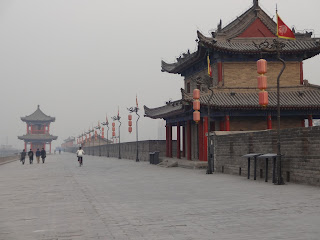


 I walked on the wall, which was wide enough to fit six carriages side-by-side, and came across two young women cycling along. They stopped to talk with me briefly, and were excited to learn that I was Canadian. They were shy and rode off, but kept catching up to me. I asked to take their picture, which must have reassured them, because they then rode alongside me until I left the wall, telling me about their studies and one’s desire to study in England after university. She was soooo excited to meet me: her second foreigner! Imagine never coming across anyone other than your fellow Chinese. After living in large, cosmopolitan cities, it seems unreal.


I also learned from the signs that rooflines, like headgear, were a sign of status and hierarchy. Only the emperor could have a Wudian roof, but the roofs on the gates of the Xi’an wall were only a step below in status. Very cool.

Speaking of cool, people here thought it was cold, but wow, after Beijing’s 10 below and the chill on the Great Wall, 2C is almost summery! And I’m certainly prepared now, clothingwise. Perfect temperature for walking – although I believe the hazy sky wasn’t doing my lungs any good. It’s pollution, alas: a combination of coal-burning power plants, vehicle exhaust and charcoal used for heating and cooking. I wonder about the impact on life expectancy.

Today was terracotta warrior day! I had a restless night, too excited to sleep well.

My guide, Bryan (Chen), met me in the lobby and we hopped into Mr. Wong’s car and headed to the outskirts of the city. Bryan has been leading tours for a number of years and he knows the ins and outs. We arrived before the bus tours so we could get a close-up look without much in the way of crowds. Apparently, in summer, you’re lucky to get a glimpse or two of the display area, but winter is much saner. I was able to linger, move around and take all the photos I wanted.


The warriors are amazing! They are a bit larger than life so as to impress at a distance, and not one of the approximately 2,000 on display is identical. There are soldiers of all ranks – and file – dressed in clothing appropriate to their ranks and missions. Shoes vary, headdresses vary, hairstyles vary, armour varies ... and that’s even without looking at facial features and moustaches.


The site of them en masse is awe-inspiring, and it’s also exciting to see the area where the archeologists are piecing together more of them. There are a number of pits at the site yet to be unearthed. It’s slow, painstaking work, but the result is stunning.


Bryan tells me the warriors were built by hand, using coiling and done in parts, which would be fired separately and then put together. The detail is marvelous – each plate of armour is distinct, and strands of hair are clear, too. Wow! I would have liked to climb into the pit and chat with them face to face, but alas, it isn’t allowed. Thank heavens for telephoto lenses.

Although the warriors were the true highlight of the day, we also visited an ancient village site in Xi’an that dates back 6,000 years. Archaeologists are still working on it, but it was a matriarchal society and it was fascinating to see the places where the shelters stood and to realize how advanced the people were so far back in history. Fishing, hunting, sewing, creating pots ... no problem.


Our final stop was the Big Goose Pagoda, dedicated to a Chinese scholar who travelled to India on foot thousands of years ago and returned with an impressive depth of knowledge of Buddhism. His trip and his writings are renowned and revered, and the pagoda is where he worked on translations of Buddhist texts from Sanskrit to Chinese.


As we entered, there was some fanfare for a Buddhist monk who was visiting. An added treat.

So, Xi’an turned out to be a treat, and having a guide added some depth to my understanding of the area. Tomorrow, it’s off to Shanghai and a very different experience.

Bye, bye Beijing!


One more sleep, as they say, and it’s off to Xian by high-speed train.

I have enjoyed Beijing very much, and would love to come back in warmer weather to see the Summer Palace and see some of the temples I missed. But, I’ve done quite a bit and enjoyed most of it – with the exception of the night I spent in a hutong hotel that had no central heating and just a tiny space heater for the room.

Picture me sleeping in long underwear AND pajamas, plus hat, gloves and booties. Very sexy! I wrapped myself in the two quilts in the room and managed to sleep, but no email that night – my hands were too cold. Needless to say, I moved hotels the following day. A good lesson for winter in Beijing – always ensure that there will be heat and hot water!

In addition to the Great Wall, the Forbidden City, Tiananmen Square and the National Museum of Art, my sightseeing mission here included the 798 Art District. It is an old factory area of Beijing that has been turned into an arts hub, with about 40 or so galleries located in a few square blocks of factory buildings and other spaces. I saw some lovely Chinese contemporary work – including an exhibition at Pace Beijing – and stumbled upon a gallery showing the work of Louise Bourgeois, the American feminist artist. I’ve seen her work in NYC and elsewhere, so it was quite a surprise.


Just as interesting was a gallery featuring work from the Democratic People’s  Republic of Korea (N. Korea). It’s not something I’d see in the Western world very often, and it was quite interesting. The work was largely brush painting, some with a modern twist, although there was one oil depicting the Korean War. The exhibit also featured an wall full of photos of Korea’s new leader, Kim Jong-un, visiting many factories and taking part in official ceremonies. Weird to find such an emphasis on the politics of the country as part of an art show.

I also took a cooking class, something suggested by one of my colleagues as a way to get a different insight into the culture. It was a wonderful idea. There were only four of us in the class: a German, a Brit, an Australian and me. The teacher was a Sichaun native who has lived in Beijing for years, and we helped her create three dishes: one Sichuanese, one Yunanese and one typical of Beijing. As we worked we learned about Chinese cooking philosophy and shared some of our own experiences.


As it turned out, I hit it off with the Australian traveller, and she invited me to join her and a friend for a Mongolian hotpot dinner. I’d done a hotpot meal in HK, but this featured the traditional brazier heated with charcoal. We had a lovely evening of cooking, eating and chatting.


Today, I indulged the sports fan side of myself and visited the 2008 Olympic sites: the famous Bird’s Nest Stadium and the Water Cube. Both are architectural delights. The Bird’s Nest is used as a snow park for kids during the winter with a snow ramp, a tubing area and giant snowmen. 


The Water Cube is used for swimming lessons and lap swims. It was fun to wander through them and think back to 2008. Wow, time flies.


So, tomorrow, on to Xian and the terracotta warriors. Beijing has been good to me, and here’s hoping that Xian is the same.